Written by Dr. Enrique Aguilar · May 17, 2026
Physicians Are Not Providers — language, ethics, and what changes when the payer names the doctor
The ACP just put it in writing in Annals. A short read on what travels across the U.S.–Mexico border, what doesn't, and where insurance is starting to rename the doctor in charge.
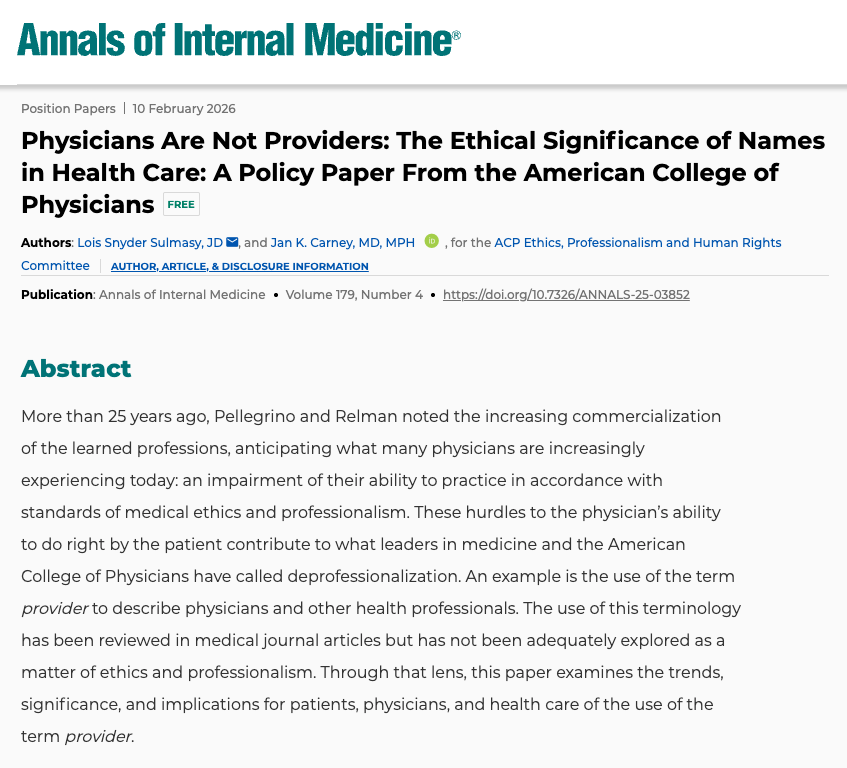
The headline
That direct is the title of the policy paper the American College of Physicians just published in Annals of Internal Medicine. Its thesis is not semantic, it is ethical: calling a physician a "provider" collapses the physician–patient relationship into a commercial transaction and dilutes the professional accountability of the person who practices medicine. Language, the authors argue, holds up — or erodes — the ethical foundations of practice.
What I see from both sides
Working in healthcare on both sides of the border, one asymmetry stands out. In Mexico, the language of medicine still reads as mostly clinical, not commercial. Proveedor — provider — is a word we associate with a business relationship, and fortunately the Mexican medical industry has not adopted it to name the doctor.
I think the reason runs deep. In the United States, "provider" bundles physicians, nurse practitioners, and other practitioners under one umbrella — largely a function of licensure and scope-of-practice. In Mexico, the medical provider — in the medical sense — is still the physician. Without a need for an umbrella term, the word never took root.
On the use of "doctor"
That doesn't mean we are purists with titles. In Mexico, the word doctor gets used generously — for dentists, nutritionists, and just about anyone in a white coat (much to the irritation of some colleagues). The difference is that this breadth is cultural and affectionate, not commercial. Nobody calls the nutritionist "doctor" to bill better.
Where the shift is starting in Mexico
Even so, private institutions in Mexico are starting to show a hint of that transition — and the engine is not the clinic, it is the payer. The term médico tratante (attending physician) is increasingly used to mark who is responsible for a case, because that is the figure the insurer enables to authorize treatment and to add other physicians to the chart. The term stops being clinical and becomes administrative: it names whom the payer validates, not necessarily whom the patient is being treated by.
And here some precision is in order, as it should be: strictly, tratante would describe any physician treating a patient — not only the one the insurer places at the head of the chart.
The open question
Does language commercialize medicine, or does it only reflect a system that already did?
Either way, the ACP gets one thing right. Words matter.
Reference
Snyder Sulmasy L, Carney JK. Physicians Are Not Providers: The Ethical Significance of Names in Health Care. Ann Intern Med. 2026. doi.org/10.7326/ANNALS-25-03852