Written by Dr. Enrique Aguilar · July 9, 2026
Stanford's AI in Healthcare: five courses, a capstone, and 54.5 CME credits
I completed the AI in Healthcare specialization from the Stanford University School of Medicine, with every course carrying AMA PRA Category 1 Credit. A note on what the program covers, why the CME detail matters, and what it changes in my work between the bedside and the software.
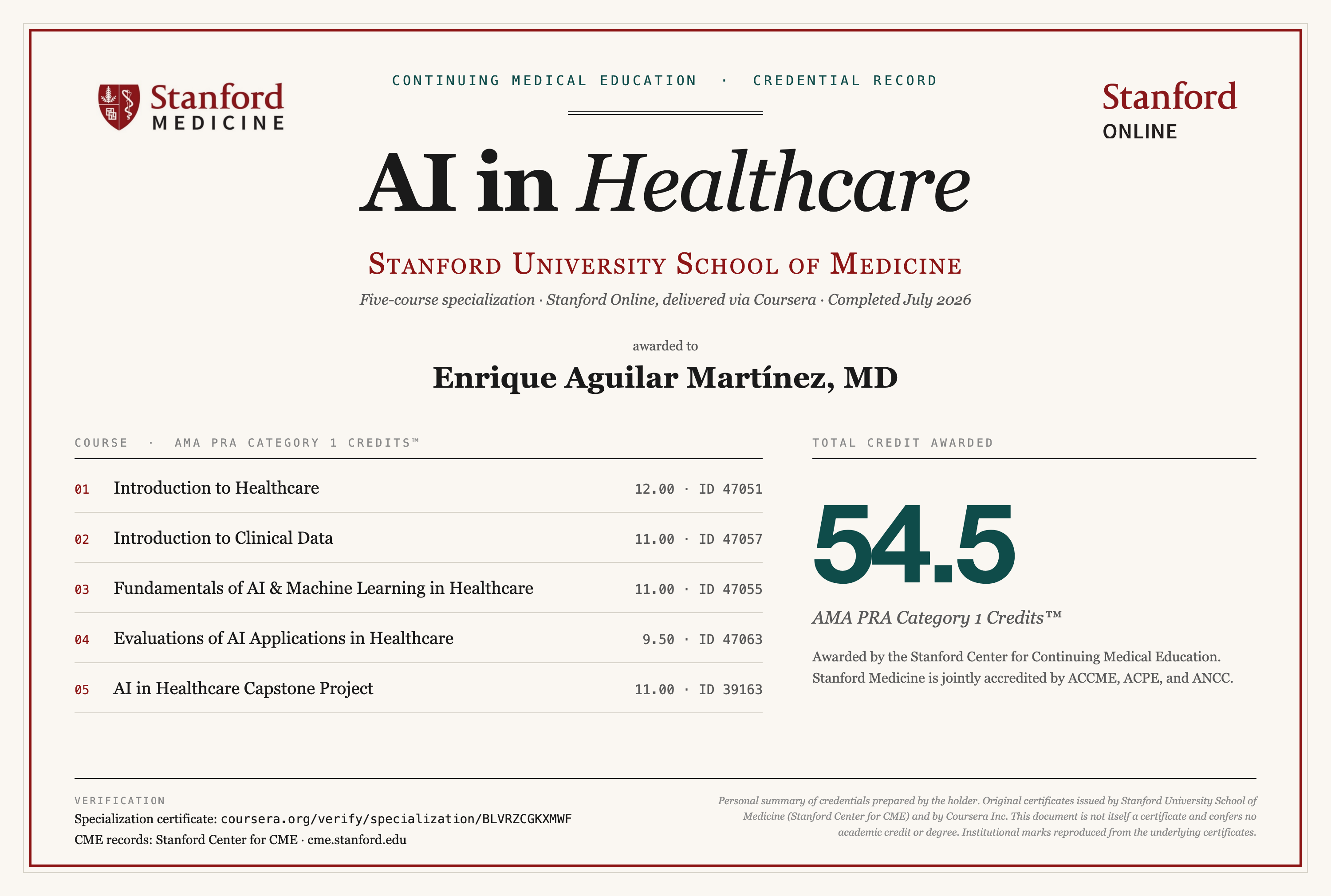
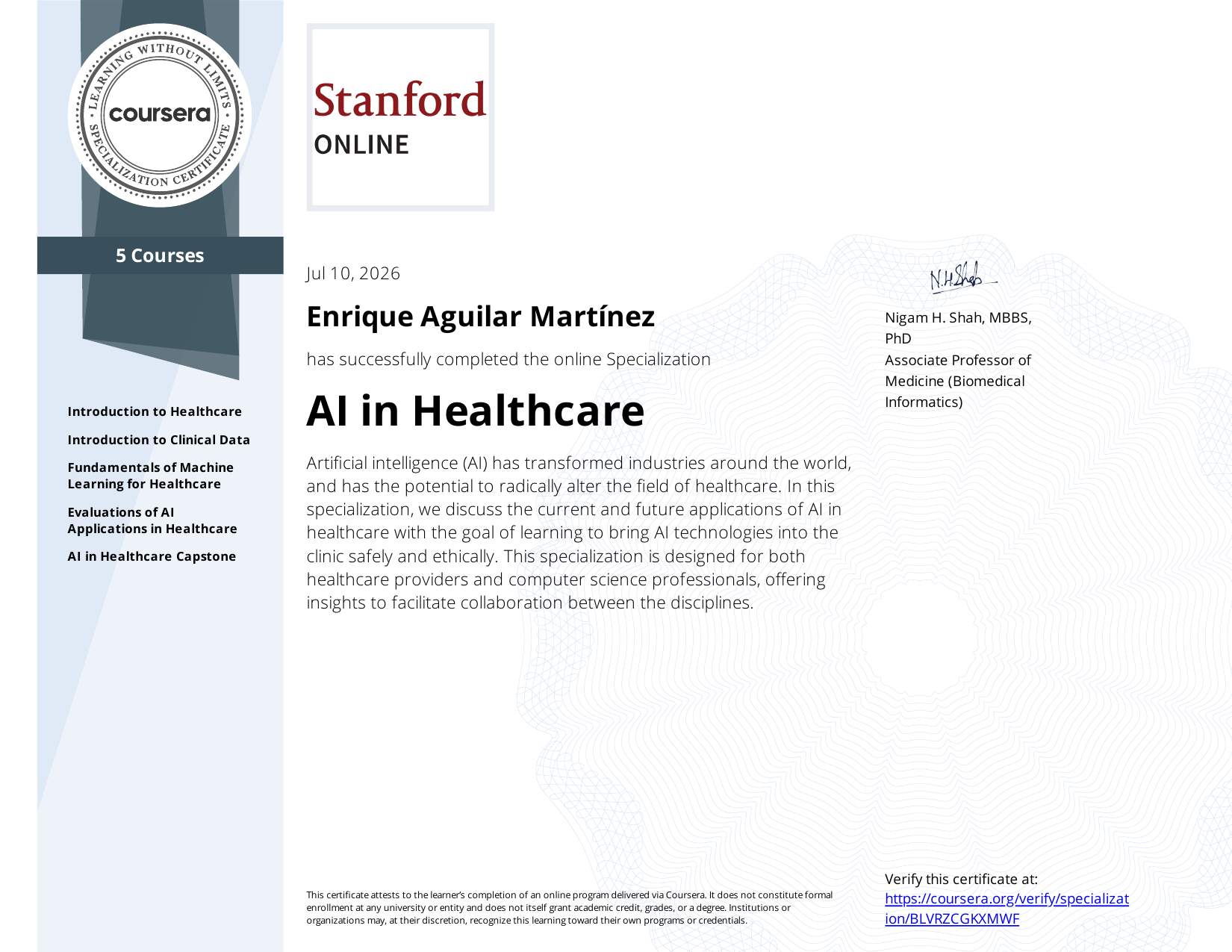
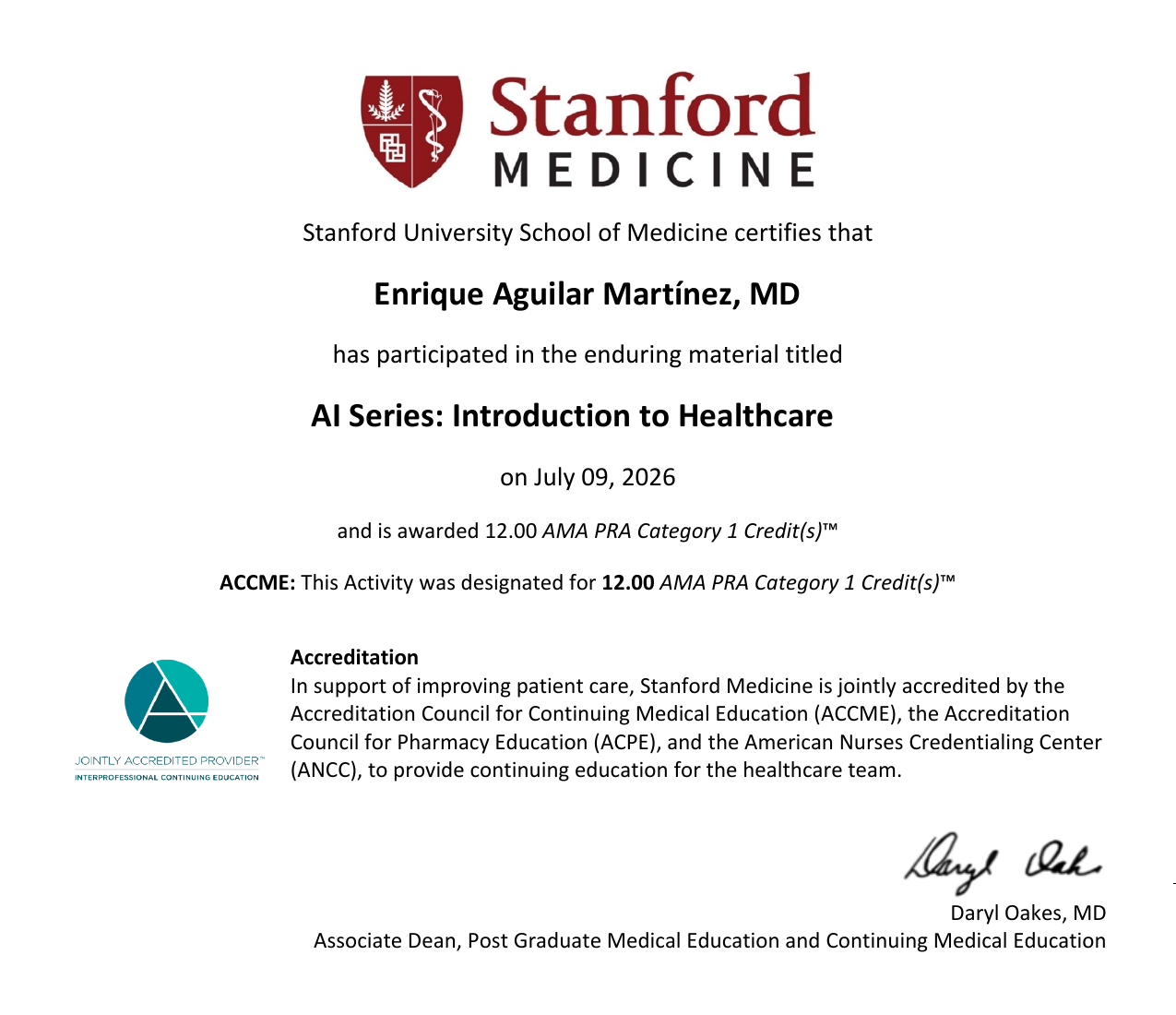
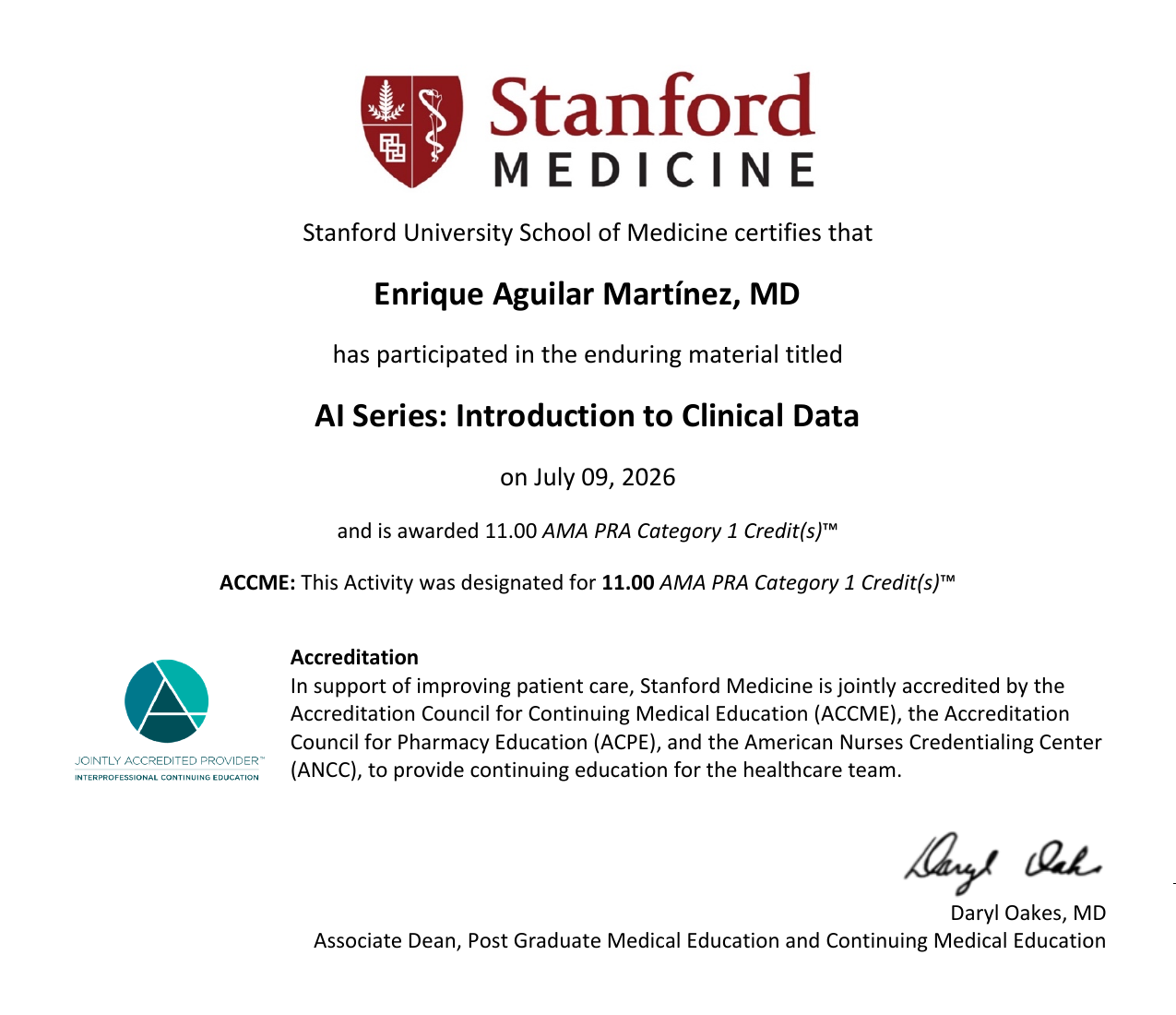
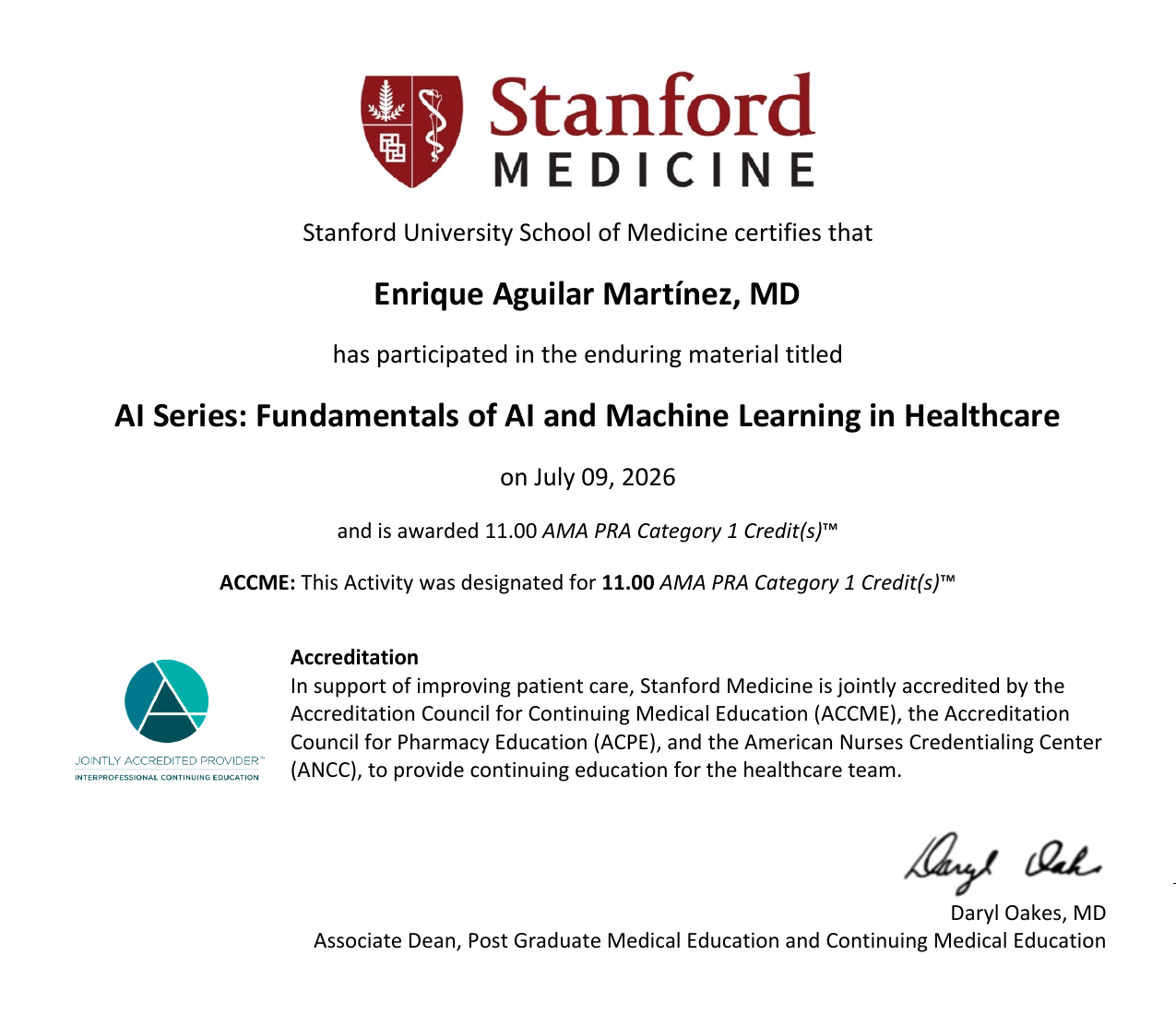
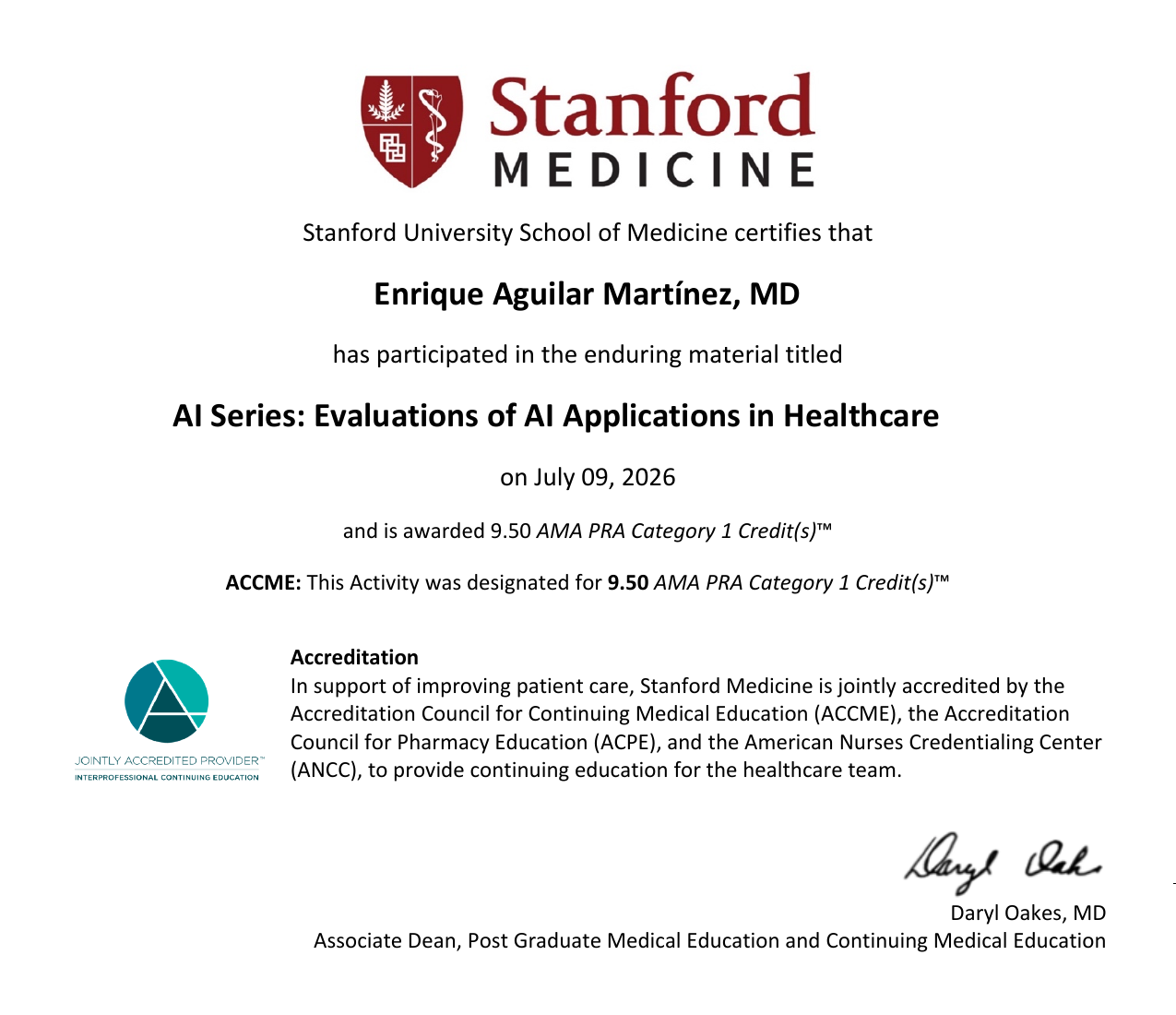
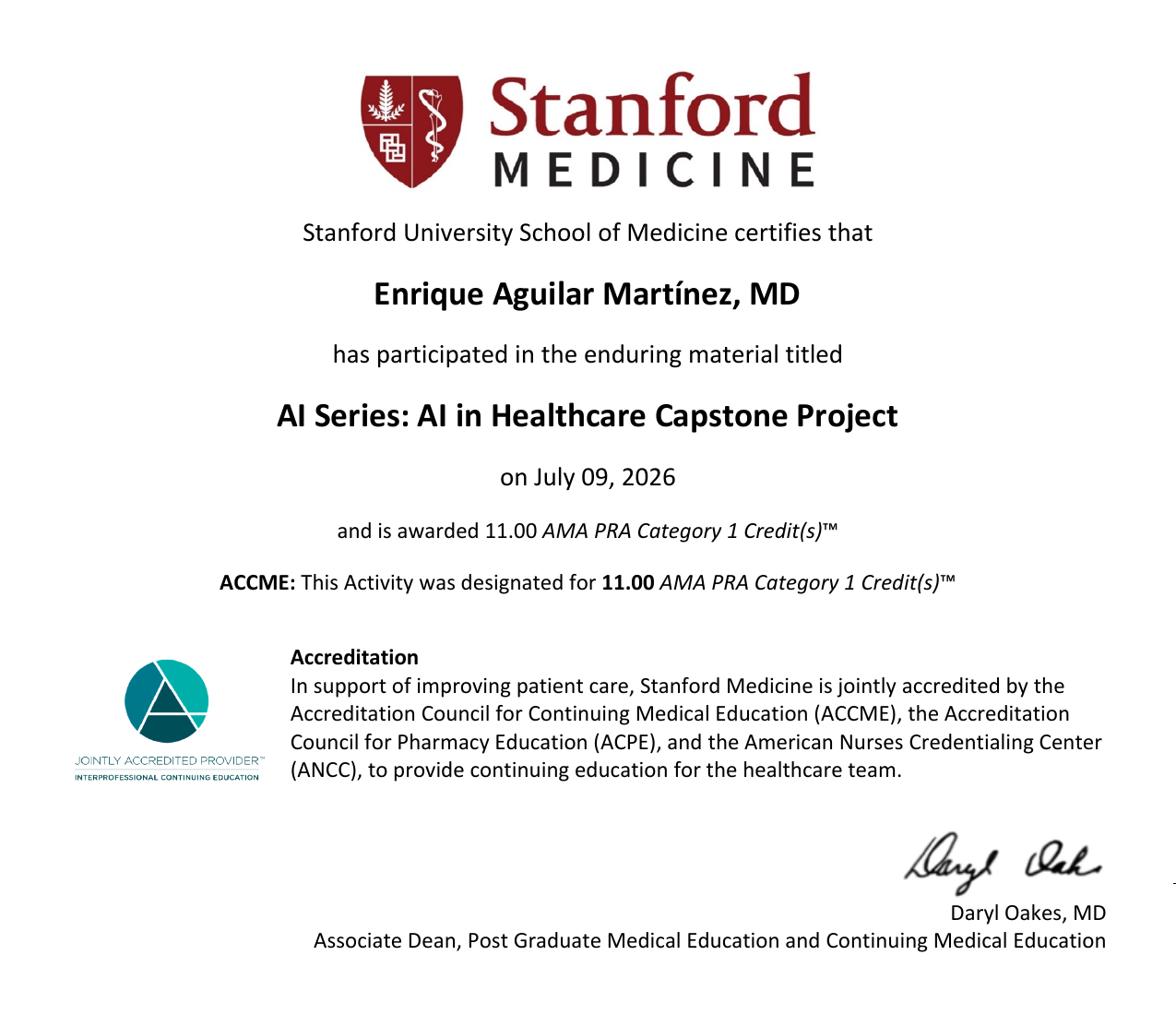
The card above is my own typographic summary of the credential set. The original certificates, issued by Stanford and Coursera, are in the carousel below, verification links included.
The short version
This July I completed AI in Healthcare, the five-course specialization from the Stanford University School of Medicine, delivered through Stanford Online on Coursera. Alongside the specialization certificate, each course was accredited as an enduring material by the Stanford Center for Continuing Medical Education, for a combined 54.5 AMA PRA Category 1 Credits™.
What the program covers
The specialization is led by Stanford faculty, with Nigam H. Shah, MBBS, PhD (Associate Professor of Medicine, Biomedical Informatics) as the closing signature. It is built for two audiences at once, clinicians and computer-science professionals, and its stated goal is the one that matters: bringing AI technologies into the clinic safely and ethically.
| # | Course | CME credits | Stanford CME ID |
|---|---|---|---|
| 01 | Introduction to Healthcare | 12.00 | 47051 |
| 02 | Introduction to Clinical Data | 11.00 | 47057 |
| 03 | Fundamentals of AI & Machine Learning in Healthcare | 11.00 | 47055 |
| 04 | Evaluations of AI Applications in Healthcare | 9.50 | 47063 |
| 05 | AI in Healthcare Capstone Project | 11.00 | 39163 |
| Total | 54.50 |
The certificates
Why the CME detail matters
Most online AI credentials live outside the currency of medicine. This one does not. Every course in the series was designated for AMA PRA Category 1 Credit™, the same unit physicians use for licensure, recertification, and hospital privileging, awarded by Stanford Medicine as a jointly accredited provider (ACCME, ACPE, ANCC).
That distinction is the whole point. It means the program was reviewed and accredited as medical education, not as a technology course that happens to mention hospitals. For a practicing physician, 54.5 credits is not a badge for a profile page; it is a meaningful block of a licensure cycle, earned entirely on the question of how AI should enter the clinic.
What this changes in my work
The honest goal of this program was to professionalize what I already do. My career has run on one thread: applying emerging technologies to healthcare. First it was web and app development around clinical services. Then virtual reality for teaching human anatomy. Then 3D printing and clinical simulation. I formalized that trajectory in 2022 at MIT Professional Education's Emerging Technologies program, and AI is the same thread carried forward. This specialization puts a medically accredited structure under it.
But "the same thread" undersells the moment. In nearly a decade of working with emerging technologies in health, I had never crossed paths with anything as disruptive as generative AI. VR changed how we teach anatomy. 3D printing changed how we prototype, plan, and train. Generative AI is changing what it means to document, decide, learn, and practice medicine, all at the same time.
That is why I believe physicians today, more than ever, have a responsibility to get involved in AI. People at the center of this shift have been saying it for years. Curtis Langlotz, director of Stanford's Center for Artificial Intelligence in Medicine and Imaging, put it plainly at RSNA in 2017: "radiologists who use AI will replace radiologists who don't". Aaron Levie, CEO of Box, pushed it further in 2025: at some point, it will be considered malpractice for your doctor not to use AI. I hold the patient's version of the same conviction: if my physician is not consulting AI on the important decisions about my health, I cannot be fully confident the decision is the right one.
Every generation of physicians has had its migration. Our teachers moved their practice into a world with the internet, and then into a world with a smartphone in every pocket. Ours is this one, and it is larger: we have to accept that the future of our profession has changed forever, and choose to help steer it rather than watch it happen. This is, in every sense of the phrase, the future of medicine.
The layer where healthcare AI actually gets decided, workflow design, evaluation criteria, who trains the clinicians and how, will be staffed by physicians who speak both languages: bedside and software. This specialization is my formal claim to that ground, and the CME accreditation makes the claim legible to the medical establishment on both sides of the border I work across.
Verification
- Specialization certificate: coursera.org/verify/specialization/BLVRZCGKXMWF
- CME credit records: Stanford Center for Continuing Medical Education, activity IDs 47051, 47057, 47055, 47063, 39163